Stepping Up to the Plate to Break the Color Barrier
By Jamin Guilbert
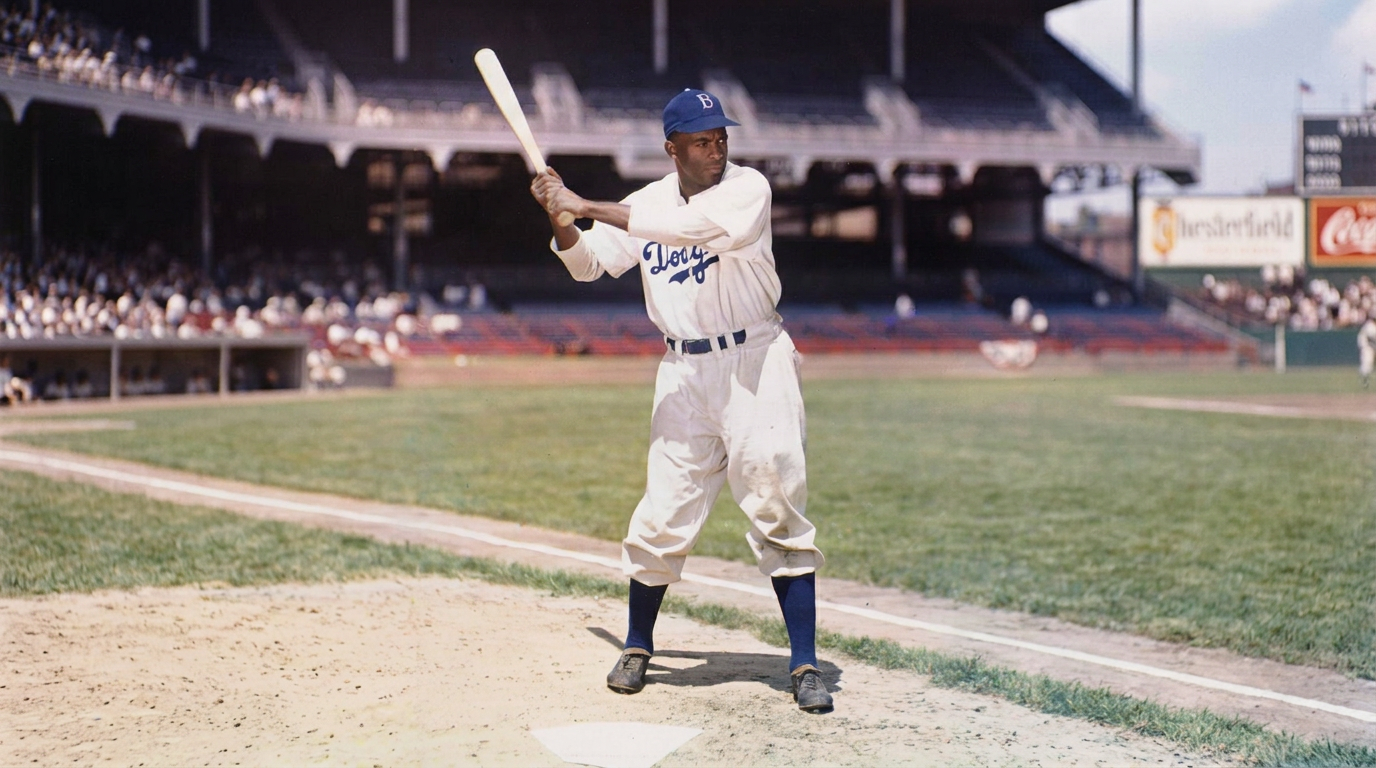
On April 15, 1947, when Jackie Robinson stepped onto the baseball field as a member of the Brooklyn Dodgers, he changed the history of American baseball forever. He became the first Black player in modern Major League Baseball (MLB) to break the color barrier that had excluded Black athletes for decades. Robinson’s step onto that field represented more than baseball. When he agreed to become the first Black player on an all-white team, he was aware of the racism, discrimination, and difficulties he would face. He was chosen for his athletic ability, his ability to withstand the pressures of segregation, and his role in leading the way for other Black athletes. His decision to break Major League Baseball’s color barrier also contributed to the broader fight for racial equality in American society (Kelly).
Growing Up in a Racially Divided America
Jack Roosevelt Robinson was born in 1919 in Cairo, Georgia. He grew up in Pasadena, CA, where he experienced poverty and racial discrimination. He excelled as an exceptional athlete, which provided him opportunities, yet his athleticism did not protect him from unequal treatment.
As an outstanding athlete, Robinson excelled in four sports while attending UCLA. He later served in the United States Army during World War II. In 1944, while in the army, Robinson refused to move to the back of a military bus in Texas. This resulted in Robinson being court-martialed on charges of insubordination. Although he was acquitted, this incident demonstrated Robinson’s willingness to challenge racial discrimination long before he broke baseball’s color barrier (Cantrell).
Robinson was honorably discharged from the US Army in November 1944, and the following year he joined the Kansas City Monarchs, a professional Black baseball team in the Negro American League. Because Black athletes were excluded from Major League Baseball, they relied on these independent leagues to play professionally. These leagues also supported and fostered Black-owned businesses, which were an important part of the local African American community. These Negro Leagues demonstrated how Black Americans created their own opportunities and institutions when segregation limited their opportunities in white organizations (Bierma).
While playing for the Monarchs, Robinson caught the attention of Brooklyn Dodgers executive Branch Rickey, who approached him about joining the Dodgers. Rickey looked beyond Robinson’s athletic ability, selecting Robinson for his character, determination, experience challenging discrimination, and willingness to handle public pressure.
Entering the league meant accepting the backlash that would follow, including intense discrimination, public opposition, and possible hostility from both rival teams and his own. He was aware that his behavior, actions, and character would be closely watched and that he would be judged more harshly because he was Black. Above all, he carried the weight both on and off the field, knowing his performance and actions could affect whether similar opportunities would be offered to other Black athletes (Kelly).
Robinson played the 1946 season for the Montreal Royals, a Dodgers minor-league team. He joined the Brooklyn Dodgers in 1947.
Breaking the Color Barrier
Robinson’s first season with the Brooklyn Dodgers in 1947 was not without difficulty. He faced racial slurs, threats, discrimination, and public opposition from both fans and opposing players. He continued to play, undeterred, showing the nation that he belonged in MLB.
Further establishing his place in MLB, he finished his first season as the first recipient of Major League Baseball’s Rookie of the Year Award (Bierma). He went on to win the National League Most Valuable Player award in 1949.
Because baseball was one of America’s favorite pastimes, Robinson’s success and accolades drew national attention. While many Americans still supported segregation, they were now seeing a Black athlete compete at the highest level alongside white teammates. Robinson’s position challenged racial boundaries long accepted as normal. Baseball became one of the places where Americans could see racial integration taking place before major civil rights legislation was passed (Kelly).
Integration also presented unanticipated consequences for Black communities. The Negro Leagues began to lose talented players as those players entered the Major Leagues. They began to lose their fan base, revenue stream, and community support. Black business owners faced financial challenges as the Negro Leagues declined. At first, many Black newspapers supported integration, but later some became concerned about its impact on the Negro Leagues (Gale). Integration created opportunities for equality and changes for American society. However, at the same time, it weakened Black-owned businesses and communities connected to the Negro Leagues. This shows that challenges facing Black communities went beyond just access to white institutions. The Negro Leagues were an example of Black self-determination and economic independence. Black Americans created their own businesses and institutions to fight segregation and racial exclusion. Integration also challenged ideas about preserving Black-owned businesses, organizations, and independence (Bierma).
Beyond Baseball: The Fight for Civil Rights
Robinson’s efforts towards racial equality were not limited to his baseball career. In later years, Robinson became a columnist, corporate executive, and political activist. He supported presidential candidates based on their positions on civil rights (Kotlowski). He was active in civil rights organizations, promoted efforts to end segregation, and used his public image and recognition to urge political leaders to act (Cantrell).
In 1958, Robinson wrote to President Dwight D. Eisenhower. He expressed his frustration with the slow progress and limited government action to create equality. He claimed that Black Americans deserved equal rights immediately and should not be asked to continue to be patient. Robinson believed the government had a responsibility to take stronger, swifter federal action on civil rights (National Archives).
Beyond politics, Robinson devoted his time and energy to youth programs. Based on his personal experiences, he knew engaging with youth and providing them opportunities was important. He strongly believed that sports could offer a pathway to success. He also recognized that sports alone were not enough to address the larger issues facing Black communities (Suddler).
Jackie Robinson’s Legacy
Jackie Robinson’s impact extends far past the baseball fields. His decision to break the color barrier in Major League Baseball created opportunities for other Black athletes. Robinson’s presence challenged segregation in American society and made integration visible through one of its most popular sports.
His historical significance isn’t limited to shattering baseball’s color line. Rather, his legacy also reflects the broader struggle for racial equality across society. His continued involvement in civil rights shows that he recognized the need for change within American social, economic, and political institutions. Aware of the personal toll and sacrifices that being the first would bring, he never hesitated; he still chose to step up to the plate.
Works Cited:
Bierma, Nathan. “Jackie Robinson and the Decline of the Negro Leagues.” Jackie Robinson: Perspectives on 42, Society for American Baseball Research, 2021, https://sabr.org/journal/article/jackie-robinson-and-the-decline-of-the-negro-leagues/
Cantrell, Amy Elizabeth. “‘A Freedom Rider Before Freedom Rides’: Jackie Robinson Beyond Baseball.” Gettysburg College Headquarters, vol. 2, no. 1, 2023, article 3, https://cupola.gettysburg.edu/cgi/viewcontent.cgi?article=1039&context=gchq
Gale, Samuel Edward. “A Bitter Partnership: The Black Press’ Contentious Relationship with the Negro Leagues in the Struggle to Integrate Major League Baseball.” The International Journal of the History of Sport, vol. 33, no. 16, 2016, pp. 1885–1903. https://www.tandfonline.com/doi/full/10.1080/09523367.2016.1202238
Kelly, John. “Integrating America: Jackie Robinson, Critical Events and Baseball Black and White.” The International Journal of the History of Sport, vol. 22, no. 6, 2005, pp. 1011–1035. https://www.tandfonline.com/doi/full/10.1080/09523360500286742
Kotlowski, Dean J. “Jackie Robinson and His Presidents: Political Endorsements and Civil Rights Advocacy.” Sports and the American Presidency: From Theodore Roosevelt to Donald Trump, edited by Adam Burns and Rivers Gambrell, Edinburgh University Press, 2023, pp. 234–255. https://www-jstor-org.proxy.lib.csus.edu/stable/pdf/10.3366/j.ctv32vqj53.15.pdf?refreqid=fastly-default%3A7f9219885ab168ab1e7061235973dcf1&ab_segments=&initiator=&acceptTC=1
National Archives. “A Letter from Jackie Robinson: Civil Rights Advocate.” National Archives, https://www.archives.gov/exhibits/featured-documents/jackie-robinson
Suddler, Carl. “Dodgers, Delinquents, and What Jackie Robinson Can Teach Us about the Intersection of Sports and the Carceral State.” Modern American History, vol. 5, no. 2, 2022, pp. 221–238. https://www.cambridge.org/core/journals/modern-american-history/article/dodgers-delinquents-and-what-jackie-robinson-can-teach-us-about-the-intersection-of-sports-and-the-carceral-state/074E09FEF79C35F9729E29683EA915C3
Warnecke, H. (1947). Jackie Robinson [Photograph]. National Portrait Gallery, Smithsonian Institution. https://www.si.edu/object/npg_NPG.97.219