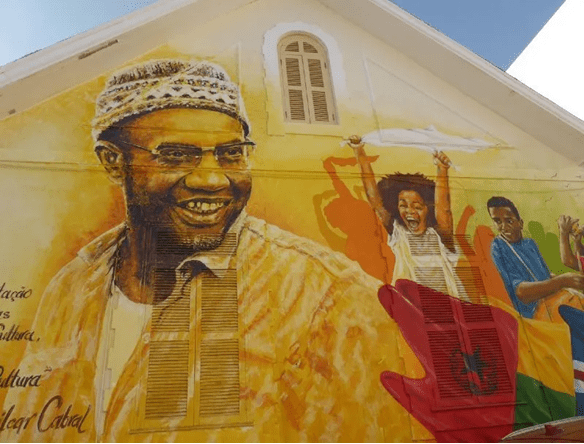
Figure 1
Biography by Louise Sally Trapps
“Claim no easy victories, tell no lies.” – Amílcar Cabral
- Father of the nation
- Architect of Pan-Africanism in the post-colonial era.
- Revolutionary Leader Cape Verde and Guinea Bissau
- Son Rise September 12, 1924, in Bafatá, Guinea-Bissau Assassination :January 20, 1974, in Conakry, Guinea.
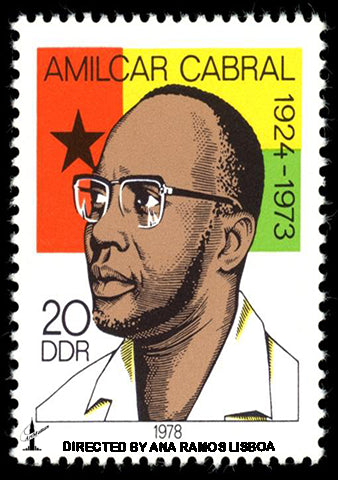
Figure 2.
Legacy Pivoted African Liberation Movement
Amílcar Cabral’s Enduring Legacy
Amílcar Cabral’s enduring legacy is evident in landmarks such as the Amílcar Cabral International Airport on Sal Island and Avenida Amílcar Cabral in Praia, Cape Verde. These tributes honor a revolutionary leader whose influence shaped the destinies of Guinea-Bissau and Cape Verde (Amílcar Cabral Foundation, “The Legacy of Cabral”). The Amílcar Cabral Foundation, dedicated to preserving his memory and promoting African identity, offers valuable insight into his lasting impact.
Cabo Verde is made up of ten volcanic islands, sitting about 570 kilometers off West Africa’s coast. In spite of its modest size, Cape Verde played a pivotal role in African liberation history—thanks in large part to Cabral. He didn’t just seek to defeat colonial powers but aimed to change society in ways that reached beyond politics, touching deeply on cultural identity and intellectual empowerment (Cabral, Revolution in Guinea). Cabral, a revolutionary thinker and agronomist, used his writing and organizing to build anti-colonial movements grounded in African culture.
The way Cabral’s ideas connect with Black American struggles for liberation is something I’ve come to appreciate more clearly. Both Cabral and U.S. Black leaders saw that freedom wasn’t just about breaking political chains—it was also about reclaiming identity. Education played a central role in this, becoming a way to restore what colonialism and racism had tried to erase. This aligns with Hasan Kwame Jeffries’ view that African freedom movements sparked a shift in how Black Americans saw their own fight for equality (Jeffries, p. 22). Jeffries is a historian whose work explores how local Black Power struggles were shaped by global liberation movements.
Cabral co-founded the African Party for the Independence of Guinea and Cape Verde (PAIGC) in 1956, a bureaucratic system that played a crucial role in the liberation of both Guinea-Bissau and Cape Verde from Portuguese colonial rule. The PAIGC was not just a political party but a movement that combined armed struggle with a strong cultural and educational focus. He famously believed that culture itself was a weapon in the fight for independence, demonstrating that real change requires both political strategy and cultural awareness (Cabral, Revolution in Guinea; “National Liberation and Culture”).
The dialogue of National Liberation and Culture, Cabral challenged the view point that colonialism does not just take land—it strikes at the heart of a people’s culture. That conception stayed with him and helped contour a adaptation of Pan-Africanism that didn’t just echo colonial structures, but actively rejected them. For Cabral, true liberation meant building a new future rooted in African values—not simply copying systems inherited from colonial powers. For him authentic freedom means restoration of pride in: African identity, reclaiming culture, and building a future rooted genuine Africanism. That is where a people’s strength truly lies—not just in winning wars, but in knowing who they are and refusing to let that be erased.
His message about cultural awareness as a revolutionary force still rings true in current struggles for justice and equality around the world. He wasn’t just a political leader—he became a symbol of the wider fight for freedom. Even after his assassination, his ideas kept inspiring people, a sign of how deeply his vision took root in the hearts of those fighting for independence (Polimeni, personal account; Cabral, Revolution in Guinea; Amílcar Cabral Foundation, “The Legacy of Cabral”). Bruna Polimeni is a contemporary Cape Verdean writer who captures the emotional impact Cabral had on those who lived through the struggle.
Moreover, the legacy of the PAIGC as a symbol of resistance and its strategies for education and culture continue to inspire liberation movements worldwide.
By empowering people in the countryside and building unity through education and culture, Cabral helped spark movements that would keep pushing for justice, peace, and real freedom long after his time. This Pan-African Studies class helped me see how Cabral’s ideas still speak to the world we’re living in today—especially when it comes to understanding the fight for justice, unity, and the right of people to shape their own future. Even the CIA World Factbook, a U.S. government publication that compiles data on countries, highlights Cape Verde’s independence and development after colonialism.
Possible Questions to Ponder:
- How can Cabral’s belief that “culture is a weapon” be applied to current movements for racial justice and identity reclamation around the world?
- In what ways do Cabral’s strategies for education and grassroots mobilization challenge modern approaches to political resistance and leadership?
Works Cited
Amílcar Cabral Foundation. The Legacy of Cabral. www.amilcarcabral.org. Accessed 8 May 2025.
Cabral, Amílcar. Revolution in Guinea: Selected Texts. Translated by Richard Handyside, Monthly Review Press, 1970.
Cabral, Amílcar. “National Liberation and Culture.” Return to the Source: Selected Texts of Amílcar Cabral, edited by Africa Information Service, Monthly Review Press, 1973, pp. 39–56.
Jeffries, Hasan Kwame. Bloody Lowndes: Civil Rights and Black Power in Alabama’s Black Belt. NYU Press, 2009.
Polimeni, Bruna. Personal account. Cited in course materials, Pan-African Studies, Spring 2025.
“Republic of Cabo Verde.” CIA World Factbook, Central Intelligence Agency, www.cia.gov/the-world-factbook/countries/cabo-verde/. Accessed 8 May 2025.
Watch & Listen
- Documentary: Amílcar Cabral (2001), directed by Ana Ramos Lisboa – A compelling film with archival footage and interviews. Available for purchase here: (AfricanFilm.com).
- YouTube: Search “Amílcar Cabral African liberation” for biographical clips and historical analyses.(Wikipedia)
- Podcast: Into Africa or Revolutions – Episodes covering Cabral’s impact on Lusophone African liberation.
- DVD: Mosaic Producciones. Amílcar Cabral. Cape Verde and Portugal, 2001. Vimeo, http://www.vimeo.com/teaseramilcarcabral. Accessed 8 May 2025.
Suggested Readings
The Revolution in Guinea by Amílcar Cabral
Unity and Struggle: Speeches and Writings by Amílcar Cabral
Amílcar Cabral: Revolutionary Leadership and People’s War by Patrick Chabal

Figure 3.
Figures
Fig. 1. Wall Drawing of Amílcar Lopes Cabral. ArtMattan Films, 2001, http://www.africanfilm.com/products/amilcar-cabral. Accessed 8 May 2025.
Fig. 2. Amílcar Cabral. Stamp, 2001, http://www.africanfilm.com/products/amilcar-cabral. Accessed 8 May 2025.
Fig 3. Map of Cape Verde. [Cape Verde Map& Facts] Reunion Technology Inc., http://www.worldatlas.com/maps/cape-verde. Accessed 8 May 2025.
 Pan African Studies Encyclopedia